| I |
 Jim Binkley is a qin player of many years standing. He lived in Taiwan in the 1970's and studied the qin under Wang Zhenhua in Taipei. At that time it was almost impossible to acquire a qin in Taiwan. Another qin teacher in Taipei at the time, Sun Yuqin, had hand-copied the second folio of the Yugu Zhai Qinpu, that dealt with qin construction. One of his students, a Mr. Pu, was assigned the task of learning to make qins according to the procedures given therein. In this he was highly successful, and made a number of good instruments. John Thompson and Jim took lessons from him in qin building. To get to the farmhouse in which Mr Pu lived, he had to take a bus for several hours, pay a boatman to take him across the river, then walk through the woods and past a temple. It was like going back 1000 years. These lessons concentrated mainly on the application of the lacquer, which is by far the most difficult part. Jim made two qins. One, he says, sounded too bright; the other wasn't bad. With help from a professor at Taipei university who was a calligrapher and musician, Jim translated this copy of the Yugu Zhai Qinpu, as well as parts of the third folio, which are on matters relating to the care of the qin.
On his return to the US two years later, he obtained a microfilm copy of the Yugu Zhai Qinpu and revised his translation, adding in those parts Mr Sun had not included in his copy, mainly literary in nature and including one poem. About five years ago, John Thompson persuaded him to put the translation online. It can be found at http://www.cs.pdx.edu/~jrb/chin/index.html.
The Yugu Zhai Qinpu was compiled by Zhu Fengjie in 1855 in Fujian Province. It consists of four folios:
According to the Yugu Zhai, a qin consists of a curved upper board made of pawlonia (tong) wood and a flat, lower board of catalpa (zimu). The light, porous upper board provides resonance;the dense lower board reinforces the sound. The pillars of Heaven and Earth are probably anti-warping devices, as well as serving to transmit sound from the top board to the bottom. Sometimes there is also a sound cavity in the head of the instrument. The bridge and nut are of a very hard wood such as zitan.
The qins Jim made each took about 3 months to complete. The lacquering accounted for most of this time, since a number of layers must be applied, and each must be allowed to dry before adding the next. Liquid lacquer is highly toxic, containing as it does the same toxin that is found in poison ivy. Some people are highly sensitive to it (Jim was not, but Mr Pu was). When used for qin making, it is normally mixed either with very fine deer-horn powder (preferably) or a substitute, such as bone, cowhorn or brick. The result, when dry, is extremely hard and durable. Some makers use just lacquer, but that is not as durable. Aside from the lacquering, other aspects that are difficult to get right include getting the correct degree of curvature on the playing surface while keeping it level, and getting the correct height for the bridge.
If a qin sounds too bright, there are two possible remedies: you can put in a nayin (a "rib" under the sound holes) or you can open it up and shave off some of the edge of the upper board (or lower board), to make the sound cavity smaller. If it sounds too "muddy", you can open it up and carefully remove wood from the upper surface of the inside.
To select a good qin, check for buzzes along the length of each string, especially around the centre, where problems are most common. Check open, stopped and harmonic tones. Check whether long sequences of slides without plucks sustain their sound. Play a few pieces on it. Also be aware of where it was made: if you take a qin that was made in the hot, humid atmosphere of southwest China to the desert of Arizona, you may have problems. It can take a long time to really know how good an instrument is, and whether it is suited to your taste and to the climate in which you will keep it.
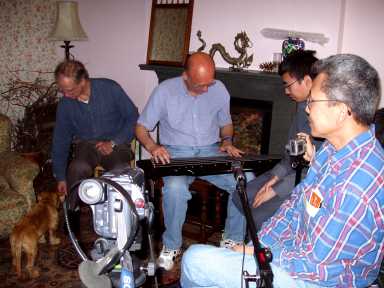 |
Jim Binkley tries out aqin. |
| Charlie Huang, a self-taught qin player from Birmingham, plays his own composition Kazuhiko no Misao (Kazuhiko's Principle). It uses a tuning he devised himself: the first, third, fourth and sixth strings are slackened; the second, fifth and seventh strings are tightened. | 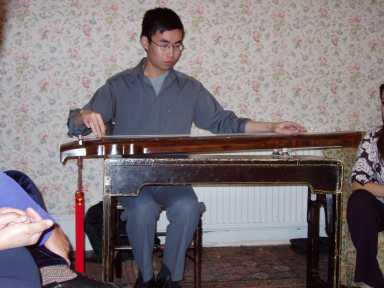 |
Copyright the London Youlan Qin Society, July, 2004. All rights reserved.